NEUROLYSIS
The external neurolysis consists of removing the scar changes, situated around the nerves, when they exert certain compression. The excision of the scar tissue is made with a sharp scalpel, always dividing tissues along the nerve axis. The operation should be done under optic magnification. The scar changes must be removed around the whole nerve up to normal tissue. Injecting local anaesthetic into the scars ensures their easier separation from the nerve.
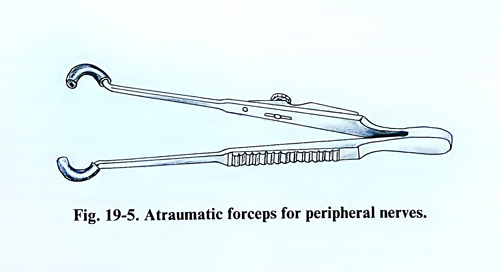
During the dissection, the nerve should be held with special forceps (Fig. 19-5), or with a rubber band, which is pulled lightly. In carrying out neurolysis it is necessary to have the epineurium intact. The nerve fascicles seem thinner on the spot, where they have been enveloped by scar tissue (Fig. 19-6).
In neurolysis, special attention should be paid to haemostasis. The haemorrhage from the small vessels near the nerve stops easily, when oxidised cellulose is put under light pressure. The vessels that continue to bleed even after this tamponade are coagulated. In applying coagulation, there should be no direct afection on the nerve surface and in its immediate neighbourhood.
During the carrying out of the neurolysis, one may notice that the tendons in the proximity of the nerve are enveloped by fibrous tissue. The latter should also be well dissected. In the reverse case, a good restoration of mobility of the limb could not be expected. Special attention should be paid to the cicatricial tissue, which envelops both the vessels and nerve. This cicatricial tissue is removed very carefully, not only from the nerves, but also from the arteries and veins, as these cause severely painful syndromes. In the presence of causalgia an excision of the sympathetic fibres that envelop the arteries could be made.
In combined lesions of nerves and bone fractures, the neurolysis has some characteristics. The nerves may be enveloped and compressed by a bone callus. In such cases fine drilling and bone instrumentation is used until the nerve is freed. This should be done very carefully, so that the nerve fascicles are not be damaged. During the mobilization of the nerve out from the bone callus a high-speed diamond drill can be used. This should not be used in the immediate vicinity of the nerve, because the high temperature can damage nerve fibres.
External neurolysis can be a separate operation, but very often it is only a stage and always precedes the resection of a neuroma, suturing the nerve, etc. The favourable influence of neurolysis for nerve regeneration is not proven, except in cases where the nerve is evidently compressed by scar tissue.
Internal neurolysis is made, when scar changes are found in the nerve itself among the nervous bundles. It should be avoided because there is a risk of a lesion of the nerve fascicles.
The careful longitudinal incision of the thick epineurium can ensure some decompression, especially if the nerve conduction is partially affected. Technically, internal neurolysis is performed in the following way: after the nerve is well isolated from the surrounding scar changes, 1 - 2% local anaesthetic is injected under the epineurium. This is done with a very fine needle along the whole nerve length, where scar changes are noticed in it. After this is made a longitudinal incision of the epineurium.
The epineurium be slightly retracted and the scar tissue between the nerve fascicles is removed with a small sharp scalpel (Fig. 19-7). This is done very slowly and carefully under a surgical microscope, taking cares not to injure nerve fascicles. The hemostasis on the nerve must be made by slight compression with cottonoids, soaked in saline or oxidised cellulose. Electrocoagulation should not be applied for this purpose. After removing the fibrous tissue, the epineurium is sutured with a few interrupted stitches, if that is possible. Resection and suture of the nerve are made, when there are clinical data of complete functional interruption, the scar tissue has massively penetrated between the nerve bundles, and when the preoperative investigations confirm this interruption. In the presence of a painful syndrome, especially of the causalgia type, it is better to make a resection of the nerve, and not internal neurolysis.