PYOGENIC VERTEBRAL OSTEOMYELITIS
Pyogenic vertebral osteomyelitis has usually a haematogenous origin. Among the pyogenic bacteria, staphylococcus aureus and coliform bacilli are most common. Compromise of the spinal cord occurs when an associated extradural abscess develops or when a bony deformity and vertebral collapse compromise the spinal canal.
Back pain is the most common initial symptom. The objective findings are minimal and limited to local tenderness and to restriction of spinal movements. Fever, leucocytosis, and weight loss occur in a minority of patients. Local pain may progress to radicular pain over periods of weeks to several months.
When compromise of the spinal cord occurs, X-ray studies, CT, MRI and/or myelography are necessary. The thoracic area is the most frequent site of osteomyelitis. If the patient is neurologically intact and the bone destruction is minimal, medical treatment is appropriate, especially if the responsible organism can be identified by needle biopsy or by blood culture. The appropriate antibiotic is given intravenously for up to 6 weeks, and if the bone destruction is arrested and pain subsides, the patient can be mobilised in a body jacket. With any progressive clinical manifestations of cord compression, surgical treatment is indicated.
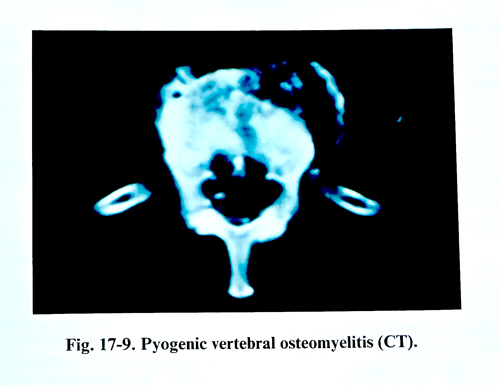
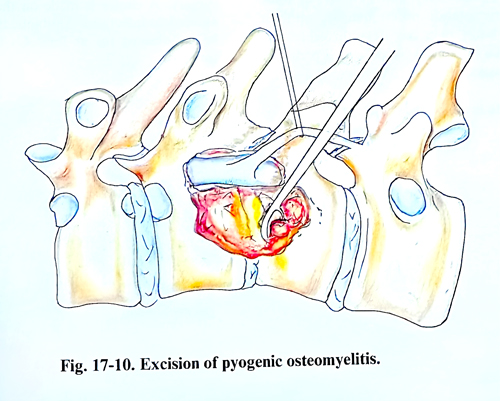
Costotransversectomy is a procedure of choice (Figs. 17-9; 17-10). The removal of the involved part of the vertebral bodies is carried out after removing transverse processes and pedicles (in a thoracic lesion including the medial portion of the corresponding rib). Anterior operations are best for those rare cases in which the patients have progressive paralysis from osteomyelitis of the cervical spine.
When spinal instability is present, long-term immobilisation by casts, halo devices, or braces must be provided.