CYSTICERCOSIS
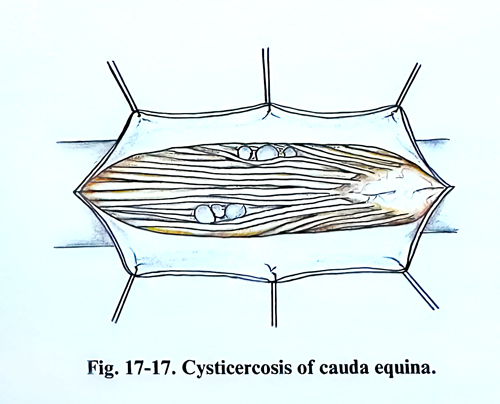
Involvement of the spinal cord is far less common than is involvement of the brain and meninges. The parasites can be found within the subarachnoid space, and even within the spinal cord. They cause compression of the spinal cord, and an inflammatory reaction in the subarachnoid space with arachnoid adhesions, which affect the spinal cord and the nerve roots. Cysticercosis of the spinal canal is usually not isolated, but accompanies cysticercosis in the cranial cavity.
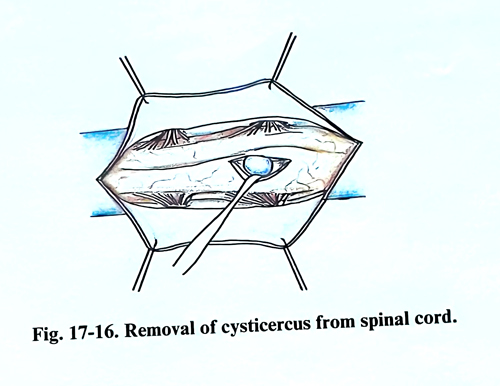
Surgical treatment is indicated in cases of a progressive syndrome of spinal cord affection. The removal of the cisticerci from the subarachnoid space does not present special difficulties. After laminectomy, the dura is opened and arachnoid adhesions are revealed, among which parasitic cysts are also seen. The arachnoid adhesions are carefully torn and the cysts easily removed, as they are free and their capsule is not attached to the spinal cord meninges. When it is a case of cysts located in the spinal cord tissue, the technique is the same as with an intramedullary tumour (Pigs. 17-16; 17-17), A small longitudinal spinal cord incision is made on the protrusion provoked by the parasite. After reaching it, the separation of the parasite from the spinal cord tissue is easy, as there are no adhesions.
After removal of the cisticerci from the subarachnoid space and the spinal cord tissue, meningoradicular irritation can be observed for some days, which then subsides relatively fast.