BRAIN ABSCESS
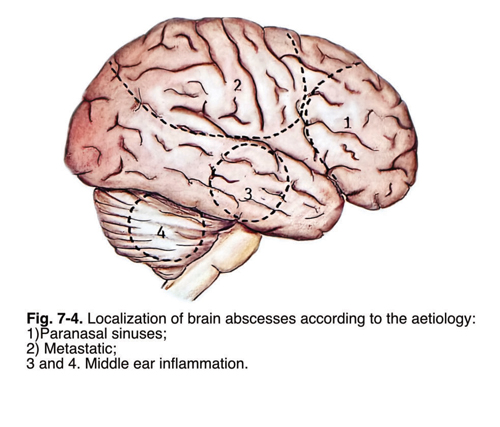
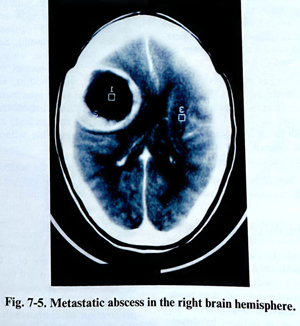
Irrespective of the fact that an abscess may develop in any part of the cranial cavity, it has a predominant localisation depending on the aetology (Fig. 7-4). Statistical data show nearly 60% of the intracranial abscesses to have an otological origin and 93% out of these are situated in the temporal lobe or in the cerebellum. About 10% of abscesses originate from infection of the air sinuses (frontal and ethmoidal and are located in the frontal lobes. Chronic pleuropulmonary sepsis, mainly in bronchiectasia and emphysema, are the most frequent causes of metastatic abscesses. They are also about 10% out of the total and are primarily located frontoparietally (Fig. 7-5). About 20% of brain abscesses have no obvious source.
Intracranial abscesses very often require surgical treatment as soon as possible after their diagnosis, as patients with abscesses, compared with those with intracranial tumours, have a bigger risk of sudden deterioration. When the general condition of the patient is good and without clinical data suggesting increased intracranial pressure, the operation is performed after complete and detailed investigations.
There have always been controversies in the evolution of the surgical treatment of brain abscesses regarding the methods to be used. The main surgical methods considered in current neurosurgical practice are puncturing and washing with antibiotics, opening and draining the abscess cavity, and excision of the capsule after puncture and aspiration.
Abscesses in an early stage (local cerebritis) can be followed up and treated conservatively. It should be a rule to evacuate any abscess larger than 2 - 2.5 cm in diameter, when a specimen for bacteriological study is required (which is almost always the case), when there are air bubbles inside the cavity or the patient has any neurological deficit.
Multiple abscesses are always treated surgically for early sampling of the causative organism when it is unknown or because of severe brain affection threatening the patient's life. All abscess cavities larger than 2 - 2.5 cm are then evacuated.