COMMISSUROTOMY
Commissurotomy consists of interruption of fibres, transmitting the pain and temperature sensations at the place where they pass through the anterior commissure. The operation has the advantage that it provokes analgesia on both sides. The analgesia is spread in the area along the dermatomes, corresponding to the segments where the incision of the spinal cord has been made.
The indications for this operation are similar to those of antero-lateral cordotomy, but the extension of the pain syndrome should not exceed the region by more than 3 - 4 dermatomes, as it would not be possible to make an incision longer than the level of 3 - 4 spinal cord segments. It is not advisable to perform this operation in the cervical region or in the conus medullaris, owing the to risks of provoking serious neurological deficit.
SURGICAL TECHNIQUE
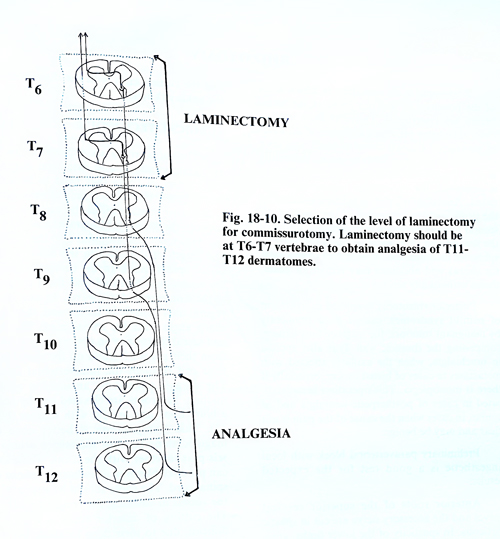
A standard laminectomy is made at the level of the segments where the commissurotomy has to be made. To determine the level of the laminectomy, it must be kept in mind that the tract transmitting the pain and temperature sensation crosses at two to three segments above the place where the posterior roots for the corresponding segment enter the spinal cord. Besides this consideration the relationship should be considered the correspondence between the spinal cord segments and the vertebrae. For instance, if by a commissurotomy analgesia has to be obtained about dermatomes T11 and T12, one must take into account that it must be made in the segments and the roots located 3 vertebrae above the respective vertebrae, i.e. at the level of the T8 - T9 vertebrae. The tracts that transmit the pain and temperature sensations cross 2 segments above and therefore the laminectomy and the incision of the spinal cord must be made at the level of the T6 - T7 vertebrae (Fig. 18-10). After the dura and the arachnoid are opened, the median fissure along the posterior surface of the spinal cord must be localised and an incision must be made along the midline 8 mm deep. It is performed with a very thin and sharp scalpel (Fig. 18-11).
After this operation, complete analgesia on the dermatomes is obtained in 60% of the patients; in 20 -30% there is diminished pain and in 10% no favour-able effect. The possible complications are some sphincter disturbances, weakness of the lower limbs and dysesthesia.