SUPRASCAPULAR NERVE
Injuries to the suprascapular nerve are rare because of its deep location. The entrapment syndrome due to compression at the place under the transverse ligament of the scapula is the most common indication for operation.
SURGICAL ANATOMY
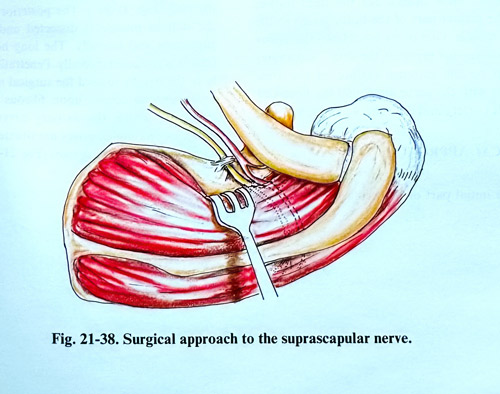
The suprascapular nerve arises from the superior trunk of brachial plexus, runs laterally under the trapezius and omohyoid muscles and passes under the transverse ligament of the scapula, penetrating the supraspinate fossa. At that place it gives off a branch for the supraspinatus muscle and later follows the lateral border of the spina scapulae, entering the infraspinal fossa, innervating the infraspinatus muscle and the shoulder joint capsule. The nerve is relatively immobile under the transverse ligament and movements of the scapula can provoke an entrapment syndrome.
Indications for surgical treatment exist when the painful syndrome is accompanied with atrophic changes in the supra- and infraspinatus muscles.
SURGICAL APPROACH TO SUPRASCAPULAR NERVE
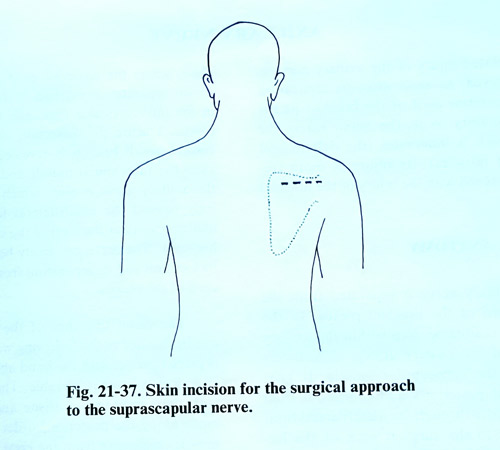
An incision of 5 - 6 cm is necessary 1 cm above and parallel to the spina scapulae with the patient in a lateral position on the operating table (Fig. 21-37). The trapezius muscle is penetrated, splitting the muscle fibres. Under this muscle the superior border of the scapula and supraspinatus muscles can be palpated. After that, the transverse ligament is dissected and the suprascapular nerve can be mobilized at that place (Fig. 21-38). After cutting the ligament, the nerve looks strangulated at this point.
Soon after the operation the pain improves and disappears, but recovery of the motor power requires a longer period.