LUMBAR DISC OPERATIONS
Surgical removal of a lumbar disc prolapse is indicated in several different conditions. The result of the surgery depends upon the correct indications for surgery. Patients who are candidates for surgical treatment can be divided into four groups:
1.Immediate surgical intervention is mandatory in acute massive disc herniation presenting with cauda equina syndrome (drop foot and sphincter troubles). Except in situations where marked spinal canal stenosis exists, a huge sequestrated fragment will be found severely compressing the roots of the cauda equina. An immediate open operation with bony decompression to allow the removal of the sequestrated fragments is required but, even when performed without delay, the results of sphincter recovery can be very disappointing.
2. In patients with lesser degrees of neurological deficit, surgery should also be considered. There is usually motor deficit of the calf muscles, weak dorsiflexion of the foot and sensory deficit in the respective dermatomes.
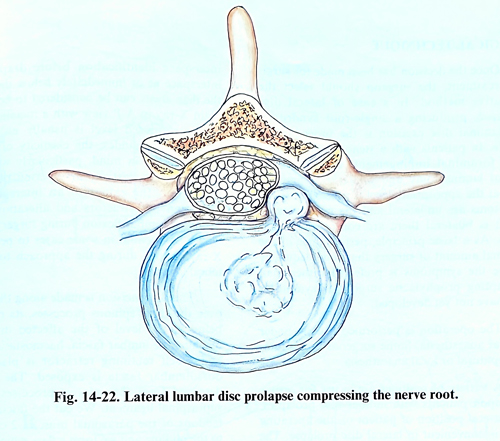
3. The most frequent indication for surgical treatment is the pain (Fig. 14-22). In some of these cases there is a mild neurological deficit, which cannot be discovered in the presence of severe pain. Surgery in this group of patients is indicated if there is a failure of conservative treatment. How much time should waited for improvement from conservative treatment is uncertain. The key to measuring the success of conservative treatment is not only the patient's relief from the leg pain but also improvement in straight leg raising ability. In patients with three to five days in bed without improvement, it is expected that the patient is going to have a protracted recovery course, for which a surgical intervention may be indicated. It is proposed that surgical treatment in the acute radicular syndrome should be performed within three months of symptoms, to try to avoid the chronic pathological changes that can occur within the nerve root.
4. In patients with recurring attacks of sciatica, that benefited from conservative treatment, discussion with them on the further course of management is appropriate, and surgical treatment may reasonably be considered to attempt to prevent further episodes.
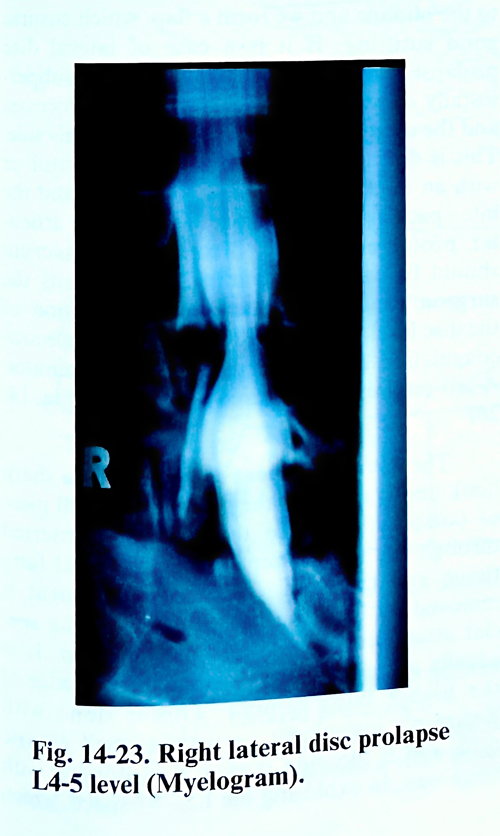
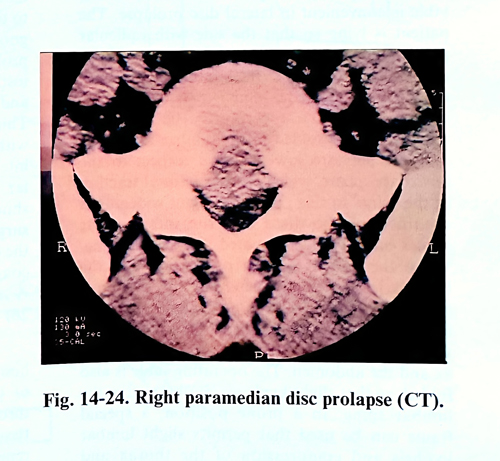
A clinical diagnosis of lumbar disc prolapse must be confirmed by appropriate radiology. It is essential that the entire lumbar canal be imaged. This is achieved by MRI, CT, myelography, and CT postmyelography (Figs. 14-23; 14-24). In many cases, two of these investigations are enough for a correct diagnosis. These investigations should be preceded by plain radiography, as abnormalities in lumbosacral segmentation may not be discerned on the MRI and CT scanning.
The surgical indications should be decided very cautiously with neurotic patients, when the subjective complaints dominate over objective information. The presence of a non-objective deficit findings reduces the success of surgery, and the surgery should proceed only following careful patient counselling with psychological support.