EXPOSURE OF THE CAROTID ARTERY AT THE NECK
Proximal control on carotid circulation and the application of endovascular techniques has demanded from neurosurgeons the exposure of carotid artery and it branches on the neck more often than any other major vessel. Not satisfied by the complications associated with the carotid ligation in intracranial aneurysms, neurosurgical community rarely resorts to it and now prefers balloon occlusions, either temporary or permanently. Ligation is discontinued also, due to the huge ascending thrombosis which follows the occlusion at the neck. The isolation of the carotid, however, remains a solution when unclippable aneurysms, or skull base tumours are treated surgically, preferably after high flow bypass. As in the cases, where temporary proximal control is needed, the carotid is exposed just before the start of the major intracranial operation.
All interventions on the carotid are preceded by detailed investigation of carotid and vertebrobasilar circulation assessing the contribution of every main vessel to the Willisian circle, with the alteration of CBF with balloon occlusion (clinical test included) and the collateralization that exists.
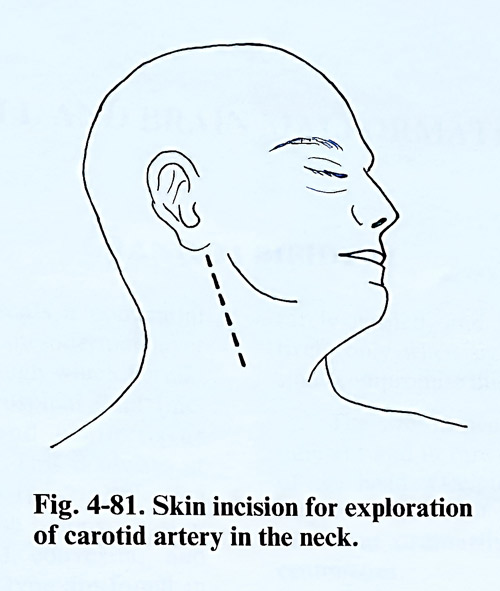
The incision has to be done along the anterior border of the sternocleidomastoid muscle or horizontally at thyroid cartilage level if only the bifurcation has to be exposed (Fig. 4-81). Platisma is incised on the same plane, with transverse cervical nerve sacrificed only if necessary. The medial edge of internal jugular vein is identified and the inflowing branches medially that obstruct dissection are divided. The descendent hypoglossal branch is retracted medially. Medially to the internal jugular vein is dissected the common carotid artery, recognised by its pulsation, and a tape is passed around it. Care is taken to separate vagus nerve, which usually lies posteriorly to the artery. Dissection is extended superiorly to the carotid bifurcation. The descendent hypoglossal branch, followed superiorly reaches the trunk of the hypoglossal nerve and sometimes is retracted additionally only after dividing its connection with the cervical nerves.
The lymphnodes over the bifurcation usually need to be removed. The area of carotid sinus can be blocked with lidocaine to avoid carotid reflex hypotension or bradicardia. If included in the aim of surgery, internal carotid is exposed additionally in distal direction between the hypoglossal nerve and the internal jugular vein.
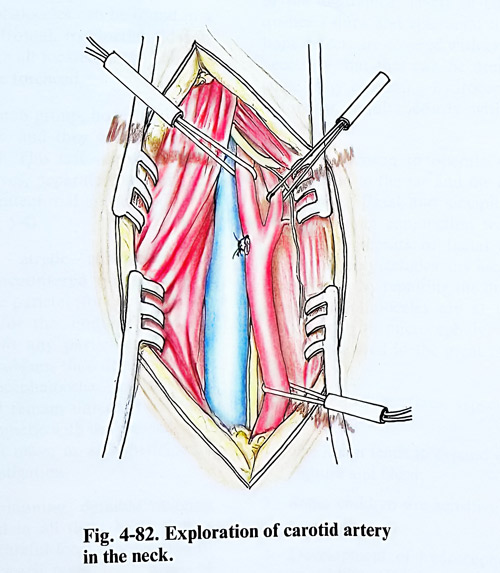
The superior thyroid artery can be found on the medial surface of the external carotid at a level just above the bifurcation. After that the external carotid is exposed to the next branch, usually the lingual artery. All big arteries (external, internal and common are held on tapes and are ready for any further intervention (Fig. 4-82).
The flow can be arrested in any of them in an emergency situation, but away from the bifurcation to avoid detachment of atheromatous debris.
Complications are rare and in quite all cases are related to ischaemia produced by carotid occlusion or emboli.